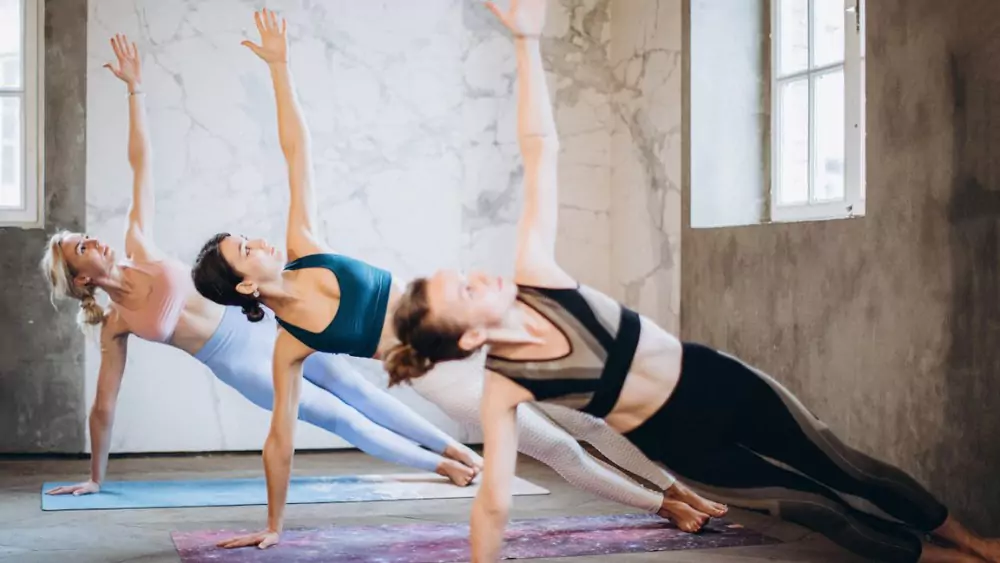
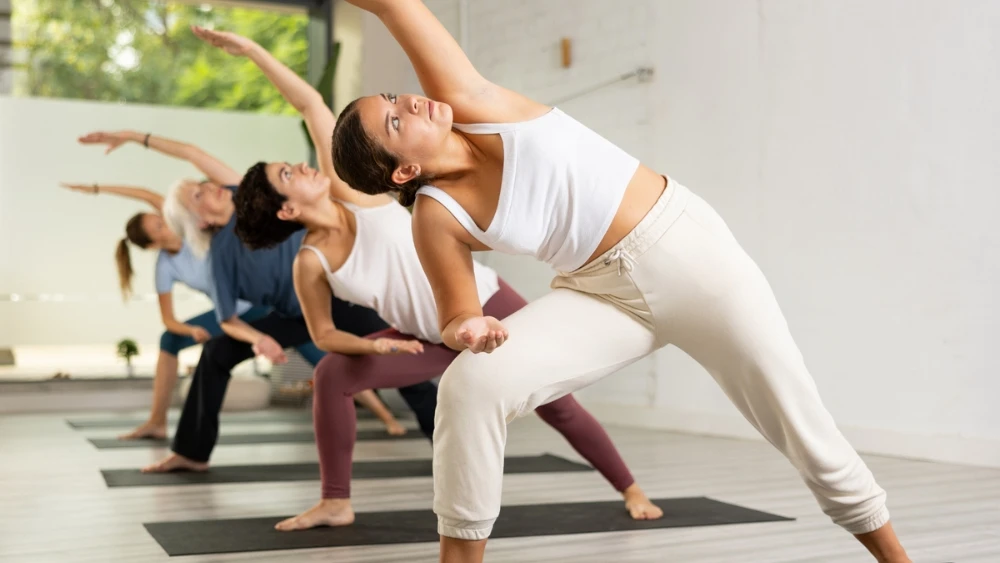
Do you believe that yoga is just a series of silent mat stretches? Rethink your thoughts. Everything you know about yoga is actually turned upside down in four-person yoga. Compared to a typical session, it is much more social, playful, and a little chaotic.
Imagine balancing in a human pyramid, stretching in sync, or relying on your friends to hold you steady while you try something new or simply enjoying a quiet group meditation session outdoors. In addition to increasing strength and adaptability, it also fosters trust and collaboration.
Fitness and fun come together in four-person yoga, whether you want to mix up your workout regimen, connect with friends, or simply try a stress-relieving activity that feels like play.
Quick Take: What Are the Best 4 Person Yoga Poses?
The best 4-person yoga poses for beginners are Group Tree Pose, Group Star Pose, Seated Circle Stretch, Four-Person Boat Pose, and Circle Forward Fold. Once your group feels steady, you can try moderate poses like Four-Person Plank, Double Downward Dog, Tabletop Square, and Downward Dog Chain. Advanced groups can move toward Four-Person Pyramid or acro-inspired balance poses, but only with mats, clear communication, and a spotter.
What Are 4 Person Yoga Poses?
4 person yoga poses are group yoga shapes practiced by four people at the same time. Some are simple partner-style poses, such as Group Tree Pose or Seated Circle Stretch. Others are acro-yoga-inspired poses that involve stacking, balancing, or supporting another person’s body weight. The safest way to practice them is to begin with standing or seated poses before moving into planks, pyramids, or lifted acro variations.
Many four-person poses are built from the same trust, balance, and communication skills used in two person yoga poses, but they need a little more coordination because the whole group has to move together. A study by Dr Arran Davis from the University of Oxford found that group exercise creates a ‘high’ that significantly strengthens social bonds compared to solo exercise.
Note: If four people feel like too much for your first session, you can begin with three person yoga poses before moving into larger group shapes.
Before You Try 4 Person Yoga Poses
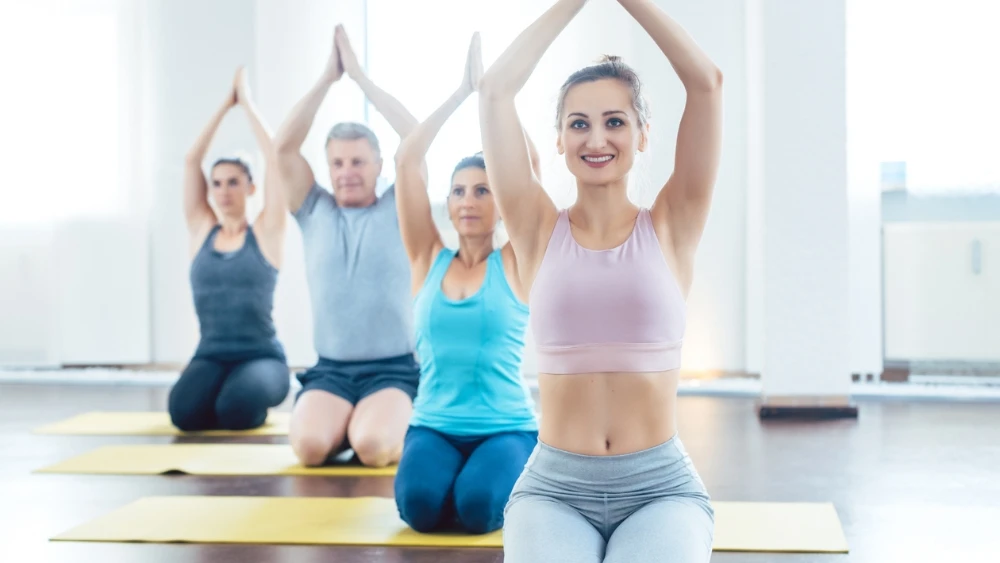
Four-person yoga can be playful and confidence-building, but it also needs patience, communication, and a safe setup. Start with beginner poses first, use yoga mats, avoid slippery floors, and keep one person as a spotter whenever a pose involves stacking, lifting, or placing feet on another person’s back.
- Do not place weight on someone’s neck, head, or lower spine.
- Step down immediately if anyone feels pain, pressure, dizziness, or panic.
- Keep the first session short and choose poses where everyone can breathe comfortably.
- For advanced acro-style poses, practice with a trained yoga or acro instructor.
Best 4 Person Yoga Poses by Difficulty
| Pose | Difficulty | Best For | Beginner Safe? |
|---|---|---|---|
| Group Tree Pose | Easy | Balance and trust | Yes |
| Group Star Pose | Easy | Team connection | Yes |
| Seated Circle Stretch | Easy | Hamstrings and gentle warm-up | Yes |
| Four-Person Boat Pose | Moderate | Core strength | Mostly |
| Four-Person Plank | Moderate | Core, arms, shoulders | With caution |
| Downward Dog Chain | Hard | Strength and coordination | No |
| Four-Person Pyramid | Advanced | Acro yoga challenge | No |
A Simple Warm-Up Before Group Yoga
Before trying any four-person yoga pose, spend 5 to 7 minutes warming up together. This helps everyone move more safely and gives the group time to settle into the same pace.
- Cat-Cow: 5 slow rounds
- Shoulder rolls: 10 each way
- Wrist circles: 10 each way
- Standing side stretch: 3 breaths per side
- Downward Dog: 3 to 5 breaths
- Easy seated breathing: 5 shared breaths
If the group feels distracted or rushed, begin with one minute of focused meditation before moving into the first pose. A calmer group usually communicates better and moves more safely.
12 Fun Yoga Poses for a Group of Four
Let’s go through the list of 12 partner yoga poses for groups of 4, which includes group tree pose, four-person plank, boat pose, downward dog pyramid and many more.
1. Group Star Pose
Difficulty: Easy
Best for: Team connection, balance, confidence, and first-time group yoga.
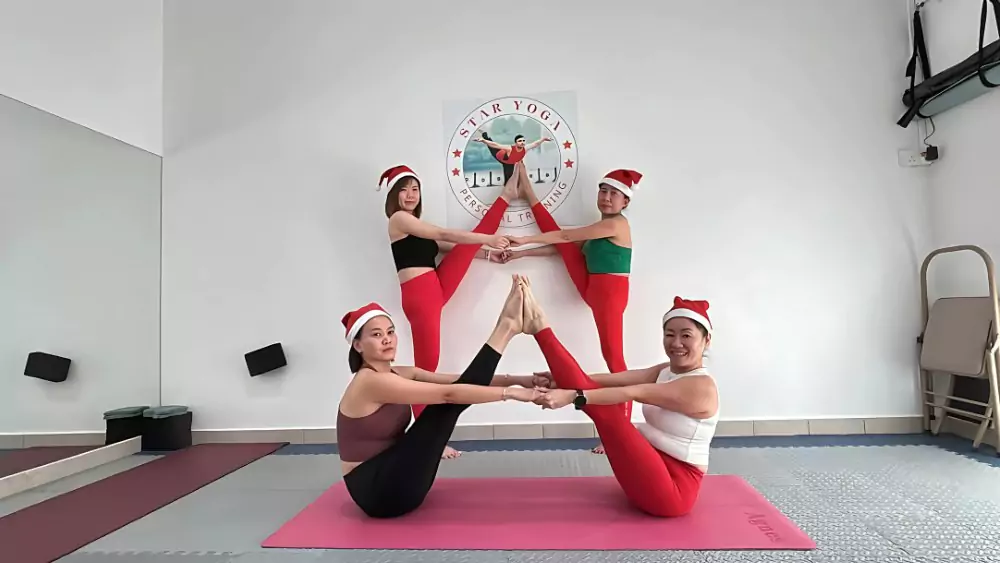
Group Star Pose is one of the easiest 4 person yoga poses because everyone stays standing and connected. Stand in a circle with your backs slightly facing the center. Hold hands with the people beside you, step your feet a little wider than hip-width apart, and gently lean outward until the group forms a soft star shape.
Keep your knees relaxed, your shoulders low, and your grip light. The goal is not to pull each other into the shape. It is to create just enough shared support that everyone feels steady.
Yoga specialist tip: Let the group breathe together for 5 slow breaths before coming back to standing. If one person feels unstable, everyone should soften their knees and reduce the lean.
Safety note: Avoid locking the elbows or pulling hard through the wrists. This pose should feel open and light, not strained.
2. Group Tree Pose
Difficulty: Easy / Beginner-friendly
Best for: Balance, focus, gentle confidence, and trust.
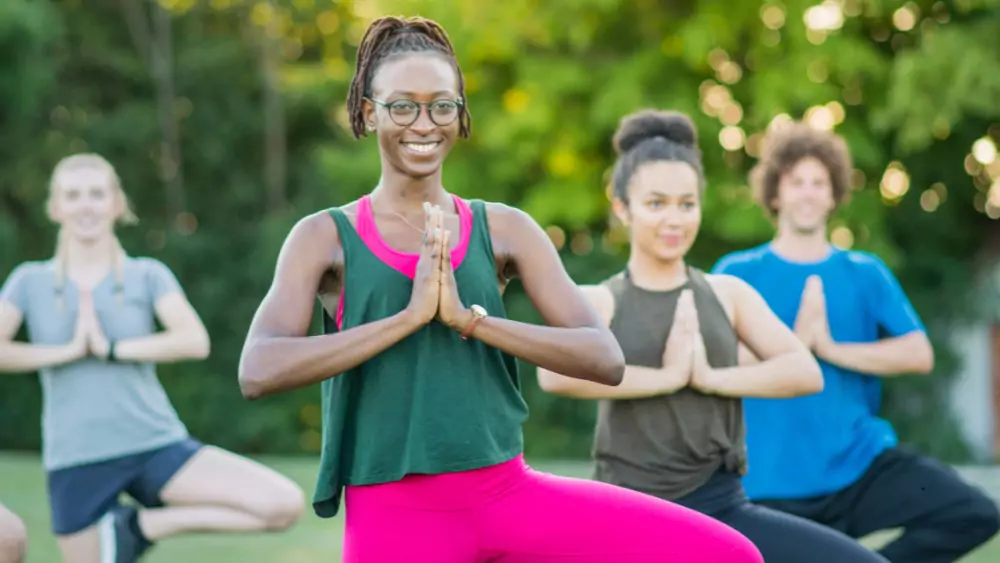
Stand in a circle with everyone facing inward. Each person shifts their weight into one standing foot and places the other foot on the inner calf or inner thigh. Avoid pressing the foot directly into the knee. Once everyone feels steady, hold hands or lightly touch the shoulders of the people beside you.
Keep your gaze soft and fixed on one point. Stay here for 5 to 8 slow breaths, then gently release and switch sides.
Yoga specialist tip: If someone wobbles, do not pull them upright. Instead, let the whole circle soften the knees slightly. A relaxed group is usually a steadier group.
Safety note: Beginners can keep the lifted foot low on the ankle or calf. There is no need to force the foot high on the thigh.
3. Seated Circle Stretch
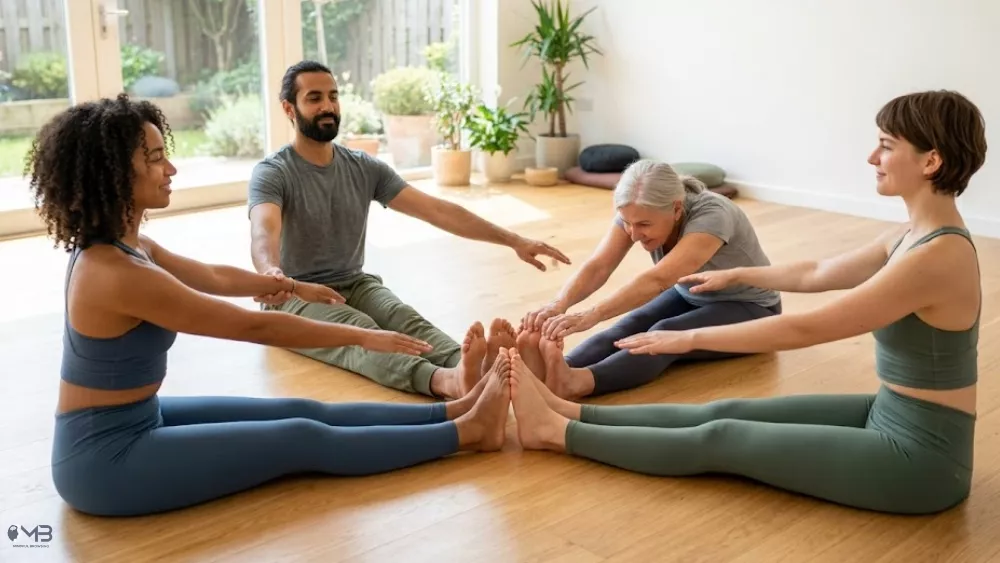
Difficulty: Easy
Best for: Hamstrings, lower back, gentle warm-up, and calming the group.
Sit in a circle with everyone facing inward. Extend your legs toward the center so the feet are close but not pushing into each other. Hold hands or gently hold wrists with the people beside you. Sit tall first, then slowly lean back a little as the person across from you folds forward.
Move slowly and take turns. One pair can lean back while the opposite pair folds forward, then switch. Keep the movement gentle and steady rather than trying to stretch deeply.
Yoga specialist tip: This pose works beautifully at the beginning of a group session because it helps everyone slow down and match each other’s rhythm.
Safety note: Do not yank or pull another person into a deeper stretch. Each person should control their own range of motion.
4. Circle Forward Fold
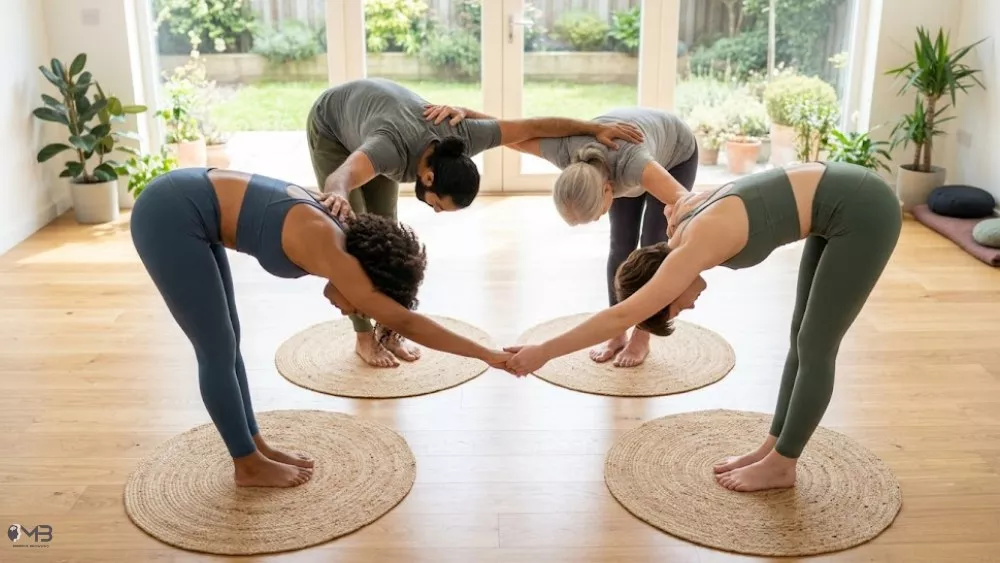
Difficulty: Easy
Best for: Relaxation, hamstrings, back release, and group breathing.
Stand in a circle with feet about hip-width apart. Hold hands or lightly rest your hands on the shoulders of the people beside you. Take a breath in together, then slowly fold forward from the hips. Let the head and neck relax while keeping the knees slightly bent.
The group does not need to fold at the same depth. Some people may only come halfway down, while others may fold deeper. Stay for 3 to 5 slow breaths, then rise back up slowly together.
Yoga specialist tip: Encourage everyone to bend their knees more than they think they need to. It makes the pose safer and more comfortable, especially for beginners.
Safety note: Anyone with dizziness, blood pressure concerns, or lower back pain should stay higher and avoid a deep forward fold.
Yoga Poses for Friends or Families
5. Four-Person Boat Pose
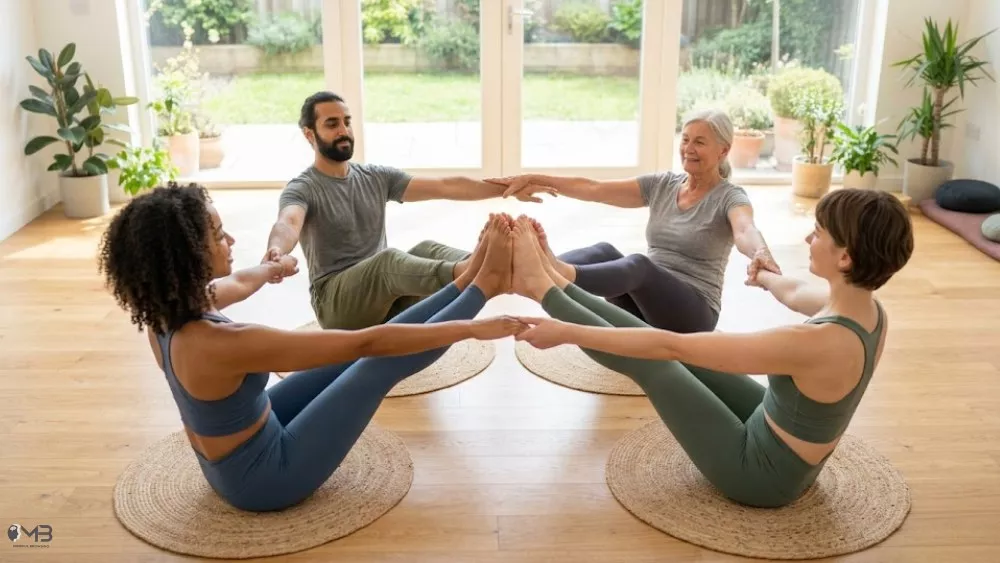
Difficulty: Moderate
Best for: Core strength, balance, coordination, and laughter.
Sit in a circle with everyone facing inward. Bend your knees and bring the soles of your feet close to the feet of the people across from you. Hold hands or wrists with the people beside you. Slowly lift one foot, then the other, until everyone is balancing on the sitting bones.
Try to press the soles of the feet lightly toward the center without pushing too hard. Keep the chest lifted and the spine long. Hold for 3 to 5 breaths, then release the feet back to the floor.
Yoga specialist tip: Start with bent knees. Straight legs look impressive, but bent knees are much safer and more realistic for most groups.
Safety note: Avoid rounding the lower back aggressively. If the back feels strained, lower the feet and reset.
6. Four-Person Plank
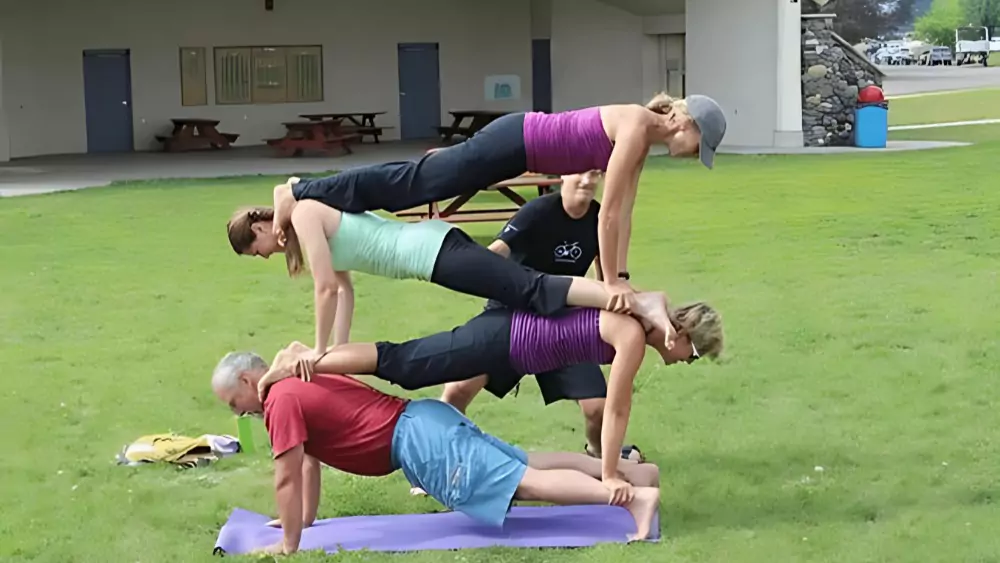
Difficulty: Moderate
Best for: Core, arms, shoulders, and group coordination.
Start with one person in a strong plank position. The second person places their feet carefully near the first person’s hips or upper glutes, then comes into plank. The third and fourth people continue the same pattern until all four people form a connected circle.
Everyone should keep the neck long, shoulders firm, and belly gently drawn in. Hold the pose for only 10 to 20 seconds in the first round, then come down slowly one person at a time.
Yoga specialist tip: This pose is not about holding for a long time. A short, controlled hold is much better than a long shaky one.
Safety note: Do not place feet on someone’s lower spine, neck, or shoulders. Keep the contact point closer to the hips or upper glutes.
7. Tabletop Square Pose
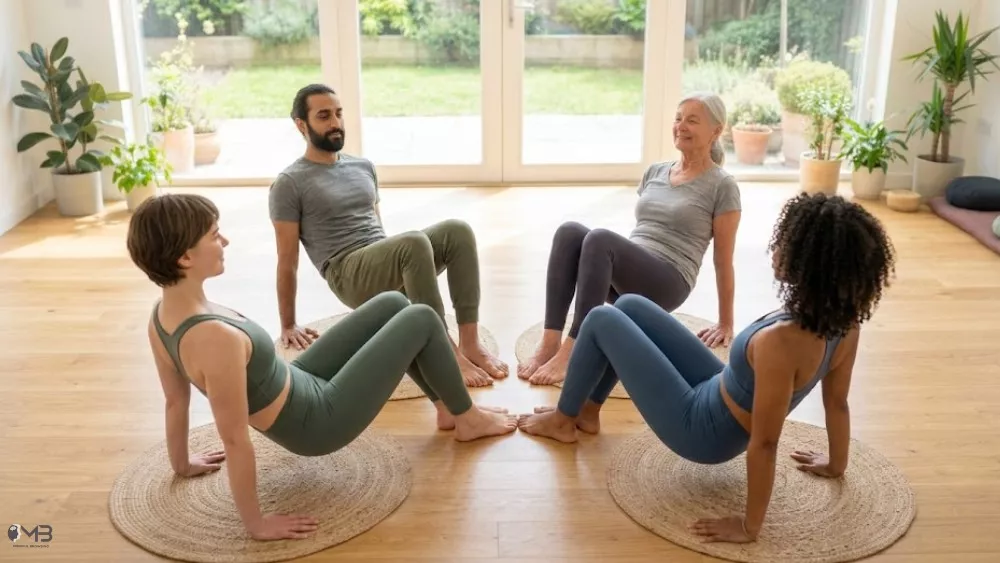
Difficulty: Moderate
Best for: Shoulder stability, glute strength, coordination, and body awareness.
Each person sits on the floor in a square shape, with knees bent and feet flat. Place your hands behind you with fingers pointing toward the feet or slightly outward. On a shared breath, press into the hands and feet to lift the hips into a reverse tabletop position.
Once everyone is lifted, the group should look like four connected sides of a square. Keep the chest open, hips lifted, and neck comfortable. Hold for 3 to 5 breaths, then lower down together.
Yoga specialist tip: Ask everyone to lift only as high as they can without pinching the lower back. A lower, steady tabletop is better than a high, uncomfortable one.
Safety note: This pose may not suit people with wrist, shoulder, or neck discomfort. Keep the head neutral instead of dropping it back.
8. Double Downward Dog
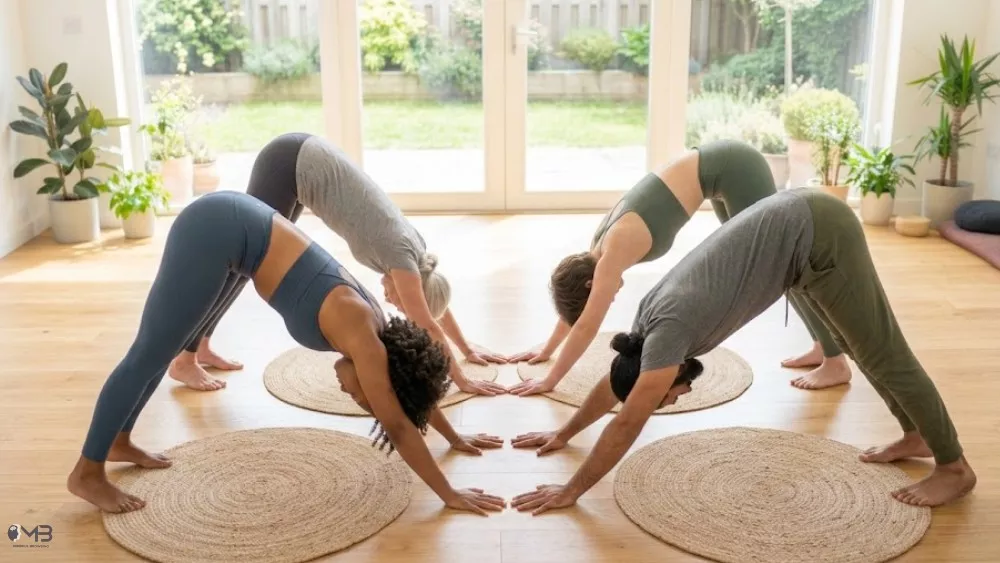
Difficulty: Moderate to Hard
Best for: Strength, flexibility, confidence, and careful teamwork.
Two people begin in Downward Dog with enough space between them. The other two people carefully place their hands on the floor and their feet near the hips or upper thighs of the base partners, creating two supported Downward Dog shapes.
Move slowly and communicate before placing any weight. The base partners should feel strong and steady before the second pair lifts fully into position.
Yoga specialist tip: Practice this first as two separate partner poses before trying it as a four-person shape. It gives everyone time to understand the pressure and balance.
Safety note: Do not place the feet on someone’s lower back, neck, or shoulders. Use mats, move slowly, and come down as soon as anyone feels unstable.
Hard 4 Person Yoga Poses for Experienced Groups
9. Downward Dog Chain
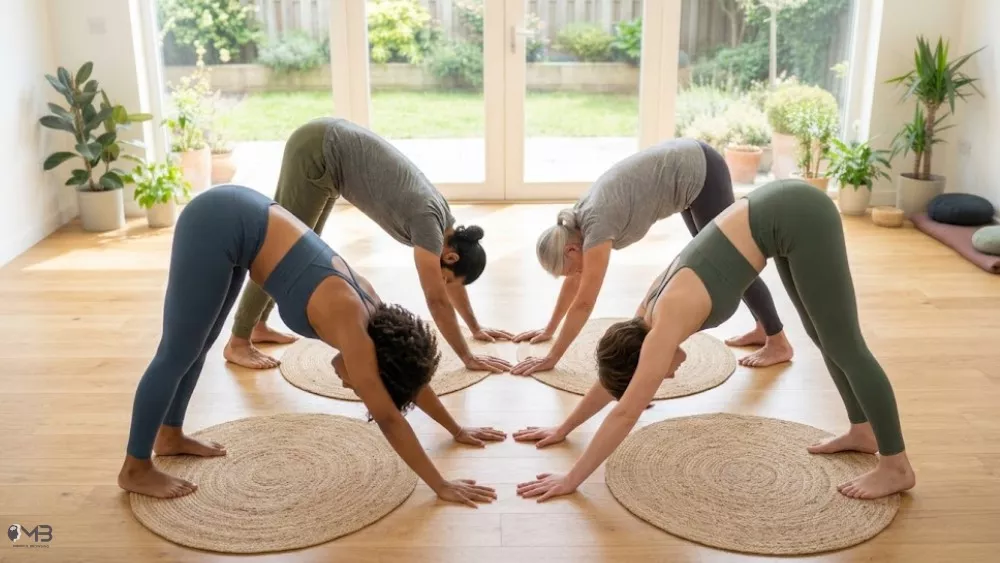
Difficulty: Hard
Best for: Strength, flexibility, balance, timing, and advanced group coordination.
One person begins in Downward Dog. The second person carefully places their feet near the first person’s hips and forms another Downward Dog behind them. The third and fourth people continue the same pattern until all four people are connected in a chain.
Everyone should move one at a time. The first person must feel stable before the next person adds weight. Once the chain is complete, hold for only a few breaths, then come down slowly in reverse order.
Yoga specialist tip: Keep the pose short. The beauty of this shape is in the teamwork, not in how long the group can hold it.
Safety note: Try this only after everyone is comfortable with regular Downward Dog and plank. Never step onto someone’s mid-back, neck, or shoulders.
10. Four-Person Pyramid
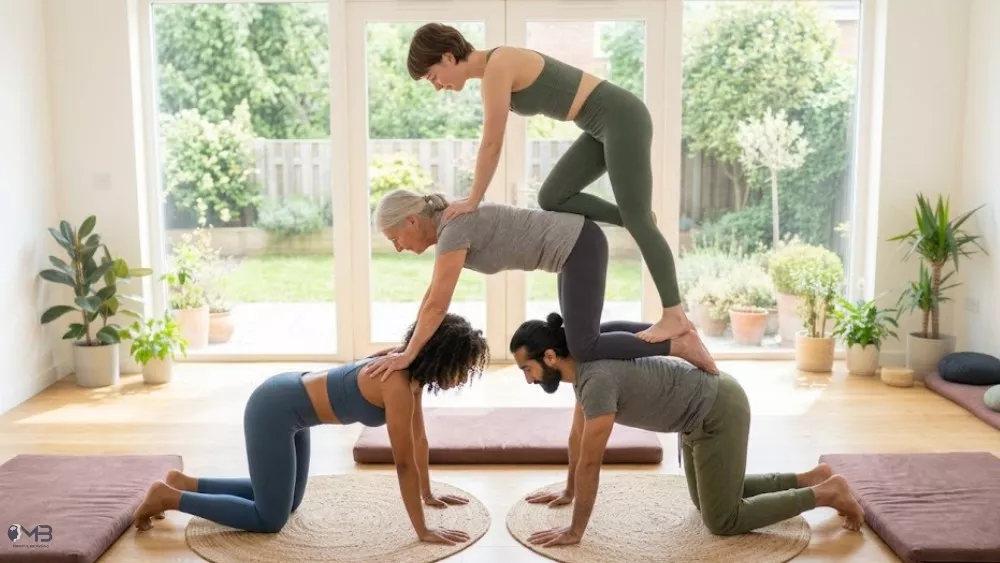
Difficulty: Advanced
Best for: Acro yoga practice, trust, strength, and group confidence.
Four-Person Pyramid is one of the more challenging 4 person yoga poses because it involves stacking and shared body weight. Two people usually create the base by coming onto hands and knees or a strong tabletop position. The third person carefully climbs into position with support, while the fourth person helps complete the shape or acts as a spotter depending on the variation.
This pose should be practiced slowly and only when everyone understands their role. The base partners need to stay strong through the arms, shoulders, and core, while the top person should move lightly and carefully.
Yoga specialist tip: Assign roles before starting: base, middle/top, and spotter. Clear roles make the pose safer and reduce confusion.
Safety note: This is not a beginner pose. Use thick mats, keep a spotter nearby, and avoid placing weight on the neck, head, or lower spine.
11. Double Boat Balance
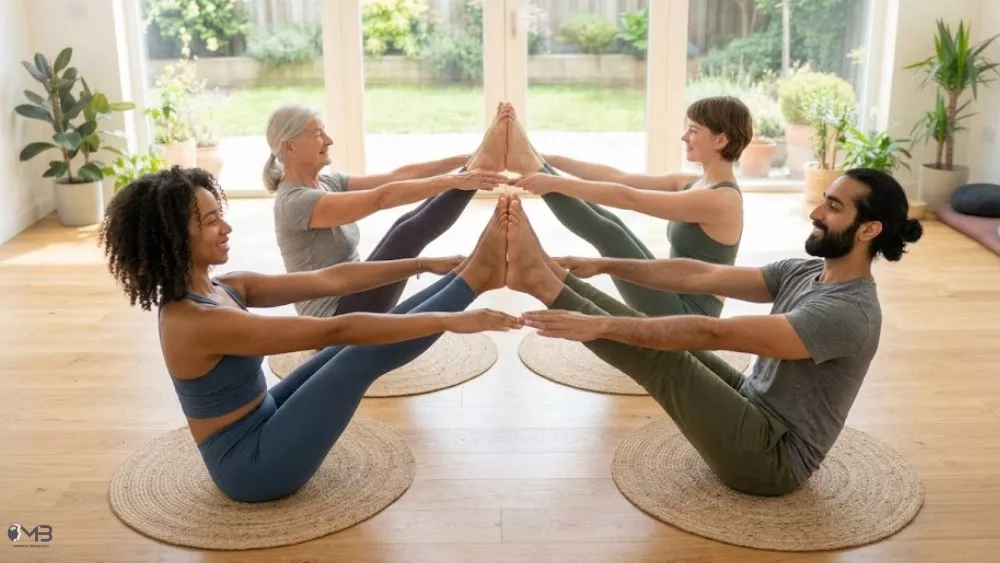
Difficulty: Advanced
Best for: Core strength, partner timing, balance, and controlled movement.
Begin with two pairs sitting opposite each other. Each pair comes into Boat Pose by holding hands and lifting the feet. Once both pairs are steady, the four people connect into one larger shape by lightly touching feet or holding hands across the center.
Keep the knees bent at first and lift through the chest. The group should breathe together and avoid leaning too far back. Hold for 3 to 5 breaths, then lower the feet with control.
Yoga specialist tip: Do not rush to straighten the legs. Bent knees help the group stay balanced and make the pose more accessible.
Safety note: Anyone with lower back discomfort should keep the feet on the floor or skip this pose.
12. Human Mandala Pose
Difficulty: Advanced
Best for: Creative group yoga, flexibility, breathwork, and mindful connection.
Human Mandala Pose is a creative four-person yoga shape where everyone forms a circular pattern with the body. The group may sit, kneel, or lie down in a circle, connecting through the hands, feet, or shoulders depending on the variation.
For a beginner-friendly version, sit in a circle with legs extended toward the center and hold hands. For a more advanced version, each person can lean, twist, or extend one leg to create a balanced mandala-like shape. Move slowly and keep the design symmetrical.
Yoga specialist tip: Treat this pose like moving art rather than a performance. The best version is the one where everyone feels comfortable and included.
Safety note: Avoid deep twists or forced leg extensions. The pose should feel creative and spacious, not compressed or painful.
Who Should Avoid 4 Person Yoga Poses?
Skip stacked or weight-bearing group poses if you have a recent shoulder, wrist, knee, neck, back, or ankle injury. Pregnant practitioners, people with dizziness or balance concerns, and complete beginners should stay with standing or seated group poses unless a qualified instructor is present.
Like any movement practice, yoga has benefits and limitations, so it helps to understand the advantages and disadvantages of yoga before trying more intense group or acro-style poses.
Benefits of Practicing Yoga Poses with Four People
As a yoga practice, four-person yoga is less about perfect shapes and more about shared awareness. You learn to notice your own balance, but you also begin to feel the rhythm, breath, and confidence of the people around you.
- Trust: Many poses require one person to support another gently and safely.
- Communication: The group has to speak clearly before moving, lifting, or changing sides.
- Balance: Poses like Group Tree and Star Pose train steadiness without making the practice too intense.
- Core strength: Plank, Boat, and Tabletop variations ask the center body to stay active.
- Connection: Moving together can make the practice feel more social than a normal solo yoga session.
The same sense of trust and shared presence can also be explored through couples meditation, especially for partners who want a calmer alternative to physical partner yoga.
Conclusion
Beginner-friendly group yoga for 4 or even advanced level poses are a fun yet effective way to build strength, flexibility, mutual trust and companionship and even reduce symptoms of anxiety, depression or feelings of isolation. If you’re still on the fence, weighing the pros and cons of yoga might help you decide. And yes, yoga isn’t just for grown-ups—you can include your babies to introduce mindfulness. Ready to strengthen your core and friendships? Namaste!
After the practice, you can sit together for a short gratitude meditation to close the session softly and appreciate the trust, support, and laughter shared during the poses.
FAQs About 4 Person Yoga Poses
Easy 4 person yoga poses include Group Star Pose, Group Tree Pose, Seated Circle Stretch, Circle Forward Fold, and Four-Person Boat Pose. These are good starting points because they do not require lifting or stacking body weight.
Some 4 person yoga poses are safe for beginners, especially standing and seated poses. Beginners should avoid stacked, lifted, or acro-style poses unless they have mats, a spotter, and guidance from an experienced instructor.
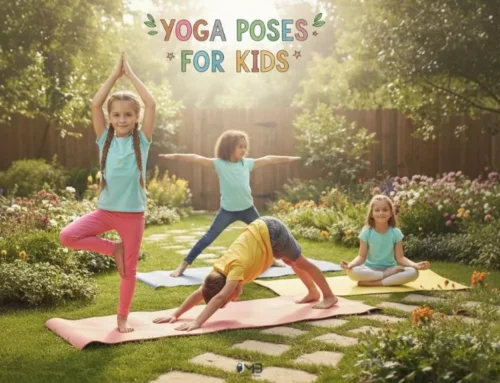
Group Star Pose and Group Tree Pose are usually the best four-person yoga poses for kids because they are playful, simple, and do not require one child to carry another child’s body weight. For younger children, it is also better to begin with simple yoga poses for kids before trying any group balance pose.
Four-Person Pyramid, Downward Dog Chain, and acro-style double bird variations are among the hardest 4 person yoga poses because they require strength, timing, body awareness, and clear communication.
Some 4 person yoga poses are inspired by acro yoga, especially when they involve lifting, stacking, or balancing on another person. Simpler standing or seated group poses are better described as partner or group yoga.
Yoga originated in ancient India over 5,000 years ago as a holistic practice blending physical postures, breath control, and meditation to promote balance between body, mind, and spirit, which leads to improved sleep, emotional, and stress regulation.
About the Author: Zainab Noor